Archive for category Uncategorized

This Is What Jesus Christ Looks Like

Matthew 25:31-46

Out of all the Disney movies I have seen, my favorite far-and-away is “Beauty and the Beast.” There are many things I love about this movie — the music, the animation, the characterization of a Disney princess who actually likes to read — but I think what grabs me most is the story. You remember the fairy tale — an enchanted prince, the Beast,meets a beautiful girl named Belle, they fall in love, there is a lot of singing and dancing, he regains his handsome appearance, and everyone lives happily ever after.

But before the love story, before the singing and the dancing, before the happily ever after, the prince is offered a choice. The prologue puts it like this:

Once upon a time, in a faraway land,
A young Prince lived in a shining castle.
Although he had everything his heart desired,
The Prince was spoiled, selfish, and unkind.

But then, one winter’s night,
An old beggar woman came to the castle
And offered him a single Rose
In return for shelter from the bitter cold.
Repulsed by her haggard appearance,
The Prince sneered at the gift,
And turned the old woman away.. .

The old woman’s ugliness melted away
To reveal a beautiful Enchantress.

The Prince tried to apologize, but it was too late,
For she had seen that there was no love in his heart.
And as punishment,
She transformed him into a hideous beast. . . .

The Rose she had offered,
Was truly an enchanted rose,
Which would bloom for many years.
If he could learn to love another,
And earn her love in return
By the time the last petal fell,
Then the spell would be broken. (Howard Ashman, “Prologue,” Disney Beauty and the Beast, 1991).

When the prince meets the enchantress, she does two things: she asks for help, and she offers him a gift. The prince says no to both the request and to the gift — how could someone who looked like this, one of ‘those people,’ have anything to offer him? The prince’s chance for redemption — a chance to love then enchantress and to accept love from her — came in a surprisingly ugly package and so, he was unable to see the power she truly offered.

Today’s Scripture describes a similar moment of redemption in ugly packaging. At the end of time, Jesus says, he will give the kingdom to the ones who have fed him, given him water, welcomed him as a stranger, provided him clothing, cared for him when he was sick and visited him when he was in prison. His listeners are confused — did all these personal encounters with Jesus Christ somehow manage to slip their mind? They ask, “Lord, when? When did we see you hungry and give you food, thirsty and give you drink? When did we see you a stranger or naked or sick or in prison and take care of you?”

His response is simple. “Truly, I tell you, just as you did it to one of the least of these, who are members of my family, you did it to me.”

Now, all of the things listed here are good things to do — they are what the church has historically referred to as “works of mercy.” When we catch someone doing one of these things — feeding the hungry, welcoming a stranger — we say, “You know, it’s a good deed you’re doing.”

And we’re right — these are good, good things to do, and the world would be a better place if we did more of these things for one another.

But what Jesus is saying here is far more radical than, “Be excellent to each other.” “Every time you do these things,” he says, “when you meet somebody hungry or thirsty or naked or strange or ill or incarcerated — that’s me. You’ve just met me, Jesus Christ, in one of my many disguises. Now act accordingly.”

Just as you do to the least of these, the least important, the least powerful, the least societally palatable — that is how you are treating me, Jesus Christ, the anointed one, God with skin on.

Wow.

For the past two months, our country has been experiencing a series of protests against economic inequality. The Occupy Wall Street movement, which began two months ago in New York City, has generated a series of similar protests in cities around the world, including our own. For the past few weeks, I have been privileged to serve as one of the volunteer chaplains for Occupy Seattle, currently on the campus of Seattle Central Community College. Occupy Seattle has a sanctuary tent, which serves as an interfaith chapel for prayer and meditation.

On a march this past week, my colleague Rich Lang of University Temple United Methodist Church was pepper-sprayed by six Seattle police officers as he attempted to separate protesters from police. There have been significant conversations this week about police brutality, freedom of assembly as well as economic inequality. At the very least, the Occupy movement has us talking.

During my service as a chaplain, I have not been pepper sprayed. Mostly, I have listened to people. I have mediated conflicts. I have had deep conversations about Jesus. And on Thursday, I marched with the occupiers to the University Bridge, praying all the while for peace and bearing a banner from the sanctuary tent, a white cloth emblazoned with a heart. I thought of the verse from Song of Songs: “He brought me to the banqueting house, and his banner over me was love.”

I listened. I marched. I prayed for peace. I was present. But mostly, in my time at Occupy, I met Jesus Christ, the incarnate God, over and over and over again. A few examples:

A nineteen-year-old pregnant woman sits next to me and scarfs down a bowl of Cocoa Puffs. She has been discharged from the hospital after being pepper-sprayed by police; the Cocoa Puffs will serve as lunch and dinner.

for I was hungry and you gave me food,

A young journalist tells me that he loves Pentecostal churches for their energy and their passion, but he feels sure they would not accept him because he is gay. He asks me, “How does the Methodist Church feel about people like me?”

I was thirsty and you gave me something to drink,

An African immigrant tells me he came here for the American dream, but somewhere along the way, it turned into the American nightmare.

I was a stranger and you welcomed me,

Two young men stop by, looking for directions to the nearest auto parts store. They want to create a warming tent where occupiers can come in during the day to get out of the cold.

I was naked and you gave me clothing,

A woman tells me she needs to leave the march early. She is the sole caregiver for her mother-in-law, who is suffering from a terminal illness. She would love to get more help, but she is unemployed and there simply isn’t the money.

I was sick and you took care of me,

A woman tells me she has chosen not to go on one of the protest marches; she is transgendered, and she worries what might happen to her if she is arrested.

I was in prison and you visited me

All of these people, all of them, are the least of these, those Jesus considers members of his family. And when we feed these folks, quench their thirst, welcome them into our homes, visit them in the lonely and dark places of their lives — we are doing these things to Jesus Christ himself.

Many of the folks I met were hungry, thirsty, sick — many could probably use some new clothes. The thing is, they hunger and thirst not just for food and for water — the people I encounter at Occupy Seattle are hungry for justice. They are thirsty for a better way, for a different world, a world in which the radical inequality we have come, as a country, to accept simply as “the way things are” is challenged for what it is: a slap in the face for the lost, the least, the lonely — the ones who Jesus claims as family, the ones who Jesus claims speak on his behalf.

According to the New York Times, income and wealth in the United States are disproportionately concentrated in the hands of the top one percent of earners. This top one percent of the country, one article claims, get about 20% of the total income generated in the United States, and they hold about 33% of the country’s wealth. (http://economix.blogs.nytimes.com/2011/10/10/about-that-99-percent/)

One percent of the people have 20% of the income and 33% of the wealth.

And we think this is normal?

A few years ago, there was a popular bumper sticker which read, “God is not a Republican. . . or a Democrat,” and, given the current state of the United States Congress, I am very, very thankful for this. The God I know is not a Republican, or a Democrat. But the God I know does care passionately about mercy and justice and care for the widow, the orphan, and the most vulnerable among us, and to pretend otherwise is to serve a different god.

If we take Jesus seriously that the hungry, the thirsty, the stranger, the prisoner, the sick and the naked are his family, are so close to his heart that they are almost indistinguishable from him, how, then, are we to respond? As followers of Jesus, if we meet him among the poor, among the 99%, what are we supposed to do?

We are supposed to love him.

We are supposed to welcome him, this Jesus, who began his life in a feeding trough because his mother was told, “There is no more room for you all here.”

We are supposed to listen to him, to be amazed at his teachings, even when they don’t seem to make sense the first time we encounter them, remembering the beautiful illogic of the wisdom of God.

We are supposed to follow him, to follow him into physical and spiritual places where we would rather not go, because we know that, in the economics of God’s love, the payoff is always, always worth the price.

We are supposed to stay with him, not to abandon him when he cries out from the place of suffering, “Why has God forsaken me?”

And we are supposed to go into the world in ministry alongside him, even when he shows up hungry or naked or thirsty or having just been arrested.

In an effort to remind this country of its proud history of free speech and free assembly, Occupy protesters will chant, “Show me what democracy looks like! This is what democracy looks like.” My friends, you ask me to show you what Jesus Christ looks like; this is what Jesus Christ looks like. My prayer is that whenever we encounter Jesus Christ among us, whether as a haggard old woman knocking on our door for shelter or in the shouting voice of a protester, that we love him, that we listen to him, that we follow him, that we stay with him, that we go out into the dark places of our world alongside him, sure in our hope that another world is possible.

Time for Everything

Although it seems like summer just returned to Seattle, autumn has undeniably begun. Children are back in school, blackberries have long-since ripened and fermented, and college football is in full swing. The air seems crisper and sharper. The laziness of August has been replaced by the busy, for some of us frantic, pace of school lunches and meetings and full calendars.

Autumn is actually my favorite time of year. Maybe it’s having spent so many years in school, but for me, autumn always carries with it a sense of expectancy, like the season is holding its breath, waiting to see what will happen next. Even as the greens of summer fade into dull brown, the brisk air keeps me awake and alert, ready to receive whatever might be headed my way.

This past weekend, nineteen GLUMC folks gathered on a Saturday morning for the first (annual?) all-church retreat. Children contemplated what God might be like; they drew pictures of their image of God, read Bible verses describing God’s compassion and collected autumn leaves from the park as artifacts of God’s creation. Adults contemplated how God was calling them to use the gift of time; they shared their dreams and heartbreaks with one another, they imagined how “sabbath time” as well as activity might deepen their relationship with the Holy One.

Autumn is a season in which we feel how finite we are; it is a season which reminds us that our time does not go on forever. It breaks our hearts, this limitation, but it also pricks our conscience to honor the time we have been given as a precious, God-given gift.

As part of the all-church retreat, we read a passage from Exodus, describing God’s unexpected gift of manna to the hungry Israelites wandering in the wilderness. In this retelling of the story, though, words like “manna” or “bread” or “food” have been replaced with words having to do with time. I invite you to read the passage this way, reflecting on how God is at work in your daily hours, in your time:

“The Lord spoke to Moses and said, “At twilight you shall eat with plenty of time, and in the morning you shall have your fill of time stretching out before you; then you shall know that I am the Lord your God.‟ In the evening, time came up and covered the camp, and in the morning, there was a layer of time upon the camp. When the Israelites saw it, they said to one another,”What is it?‟ Moses said to them, „It is the time that the Lord has give you. This is what the Lord has commanded: “Take as much time as you need for the day.” . . The house of Israel called it ‘time’; it was a new gift every day. (adapted from Exodus 16:4-31 by Dorothy Bass)

How will you celebrate God’s gift of time this day?

Making Space In Our Hearts

There is a famous proverb about becoming a parent. “Having a child,” it goes, “is like having part of your heart walking around outside your body.” For many parents, this proverb rings true. Having a child, a child whom you love more than anything in the world, makes you that vulnerable, that open to hurt, that open to being touched by the forces of good and evil in the world. Many of us were fortunate enough to be parented by somebody who loved us this way, who loved us as a piece of their own heart, who struggled with the desperate desire to protect us while having to come to terms with the fact that they couldn’t, not really.

Wherever our heart lies, be it deep within us, or in a child or in the places and people which are most deeply beloved, wherever our heart lies, lies a fierce desire to protect, to shield, to shore up for woundedness. But we know that such protection is ultimately impossible, that shielding our hearts, and the people who hold our hearts, from pain would also shield them from love. And who wants a heart that cannot love?

Then, with great passion also can come great self-righteousness. If we really, really love something or someone, it can seem sometimes like the whole world ought to feel the same way. I have read books, watched movies, seen plays that have moved me so deeply that I’ve rushed off to tell someone about the experience only to have them respond, “Yeah, I read that. I saw that. It was okay.”
“Just okay?” I holler. “How can you experience this amazing work of art, something which touched my heart and moved me to tears, only to think It was JUST OKAY?”

“I don’t know. It just wasn’t my thing.”

When I get passionate about something to the point that it has taken a piece of my heart, I have a hard time understanding why the whole world doesn’t feel the same way I do. I forget, sometimes, that there’s no accounting for taste. I forget that taste, that personal preferences, are not ultimately what calls to my heart. I am passionate, my heart leaps out of my body, whenever I see God’s compassion, God’s truth, God’s peace, God’s all-encompassing, boundary-breaking love saying ‘no’ to the forces of darkness. My passion responds to God’s compassion, and such compassion is never bound by any single language or musical style or type of cooking or kind of writing; God speaks many more languages than I do, and for this, I give thanks.

The first scripture we read this morning, Paul was talking to people like me, who were so busy looking at the objects of their passions that they failed to see God’s compassion. The community he wrote to was arguing not about movies and books and kinds of music but about what to eat and when to worship and who to have sex with. Books, movies, food, sex – it doesn’t really matter. What matters is Paul’s response: none of this matters. “Why do you pass judgement on your brother or sister?” he writes. What matters is not exactly what we do or do not do with our bodies, but whether what we do with our lives belongs to God. “If we live, we live to the Lord, and if we die, we di to the Lord; so then , whether we live or whether we die, we are the Lord’s.” It’s not the passion; it’s the compassion, the God who feels our joys and pains WITH us, from whom neither life nor death shall separate us.

And yet, there is something in us that clings to the particular. Even if we can live and let live when it comes to food or sex or money or even politics, there is something in us which insists on judgement. People who do wrong – and make no mistake, there are many people who do wrong – must be punished. And we like to get particular about how.

In Jesus’ parable of the unforgiving slave, a slave owes the lord a whole lot of money, the equivalent of millions of dollars. He begs, “Have patience with me,” and the lord, to whom he is indebted, releases him and forgives the debt.

The same slave meets his companion, who owes him a few dollars, and immediately demands payment. The companion begs, “Have patience with me,” and the slave exacts justice, throws him in prison. When the lord fids out he responds, “I forgave you that debt because you pleaded with me. Should you not have had mercy on your fellow-slave, as I had mercy on you?”

Jesus tells this story in response to a question. His disciple, Peter, wants to know about forgiveness, specifically what kind of limits he can place on forgiveness. When Peter asks, “should I forgive as many as seven times?” Jesus responds, “seventy-times-seven times,” which is Bible-speak for “as many times as it takes.” Jesus tells Peter the story of the slave, who receives forgivenss but forgets how to give it, and he concludes his story with the lord imprisoning the slave, reminding us that we all must “forgive your brother and sister from your heart.”

Really?

Forgiveness is really, really hard. And I’m not sure it’s always called for; for someone being physically or sexually abused, for example, is not called first to forgive, but first and foremost to get someplace safe where they will not be hurt anymore. Does forgiveness mean saying abuse and violence are okay? Does forgiving seventy-times-seven times mean I have to let someone keep hurting me?

No, and no. The God of compassion, who calls us into reconciliation with our brother and sister, does not call for increased violence. Forgiving and condoning are not the same.
So what does it mean to forgive?

I am struck by the language that the slaves use in this parable when they seek forgiveness of their debts. “Have patience with me” they plead, “and I will pay you everything.” Have patience with me. Forgiveness takes patience, both with the one we are trying to forgive and with ourselves as we wrestle with pain and rage and the stuckness of wanting to forgive, but just not being able to.

When you read about people who have forgiven – not just forgiven someone for cutting them off in the parking lot but forgiven someone for gross injustice – forgiveness does not come quickly. The person struggles, often for years. And then, they will sometimes say, after years of wrestling and lamenting and weeping and revenge fantasies, one morning the forgiveness just came, just washed over them like a wave, and the feelings dissolved. Forgiveness is something we can choose to practice, but ultimately, forgiveness is a gift given to us by God, in God’s good time.

In Jesus’ parable, I notice something else: it is the lord who forgives the slave, not the slave who forgives the lord. In every Biblical example of forgiveness, it is someone more powerful who can forgive someone with less power. To forgive, as Jesus says, from the heart, we need to be able to see our brother, our sister, our enemy not as someone who has power over us, but as someone who is weak, who is vulnerable, who is someone’s child, someone’s heart, living and walking around outside their parents’ bodies.

Forgiveness takes practice. It takes work. It takes patience. And it takes time. But in our God, the God who marries passion with compassion, the God in whom we live and die, the God whose heart lives among us in the form of a vulnerable child, all things are possible, even forgiveness. And in this I hope: when I can see the world with God’s eyes, I see each of us as God’s children, pieces of God’s heart, walking around outside of God’s body. And if God can be that vulnerable, that open to compassion, then maybe, just maybe, so can I. So can we all. Amen.

Loving Each Other In Word & Deed

When people ask me about my faith, I pause. Part of me always wants to say, “I’m a Christian… but not the kind you think.” For many in our community, Christians are associated not with unconditional love, but with hate-filled, narrow-minded, judgmental rhetoric.

If that’s being a Christian, I want no part of it.

To me, being a Christian means being a follower of Jesus, a disciple of Christ. I’m not alone in this; In the Unites Methodist Church, we say our mission is “to make disciples of Jesus Christ for the transformation of the world.” We believe that, when we follow Jesus more closely, we will transform a hurting, broken world crying out for love. Personal and social holiness are never, ever separate.

Sometimes, we are so scared of being identified with “those kinds of Christians” that we have stopped talking about our faith at all. Other times, we lull ourselves into believing that, when we say our prayers and attend worship, God gives us a free pass on working to transform the world in which we live.

We need both. We need to find words to speak out loud about our relationship with God. We need to love God’s world the way God loves us, to find everyday and extraordinary ways of transforming the world around us.

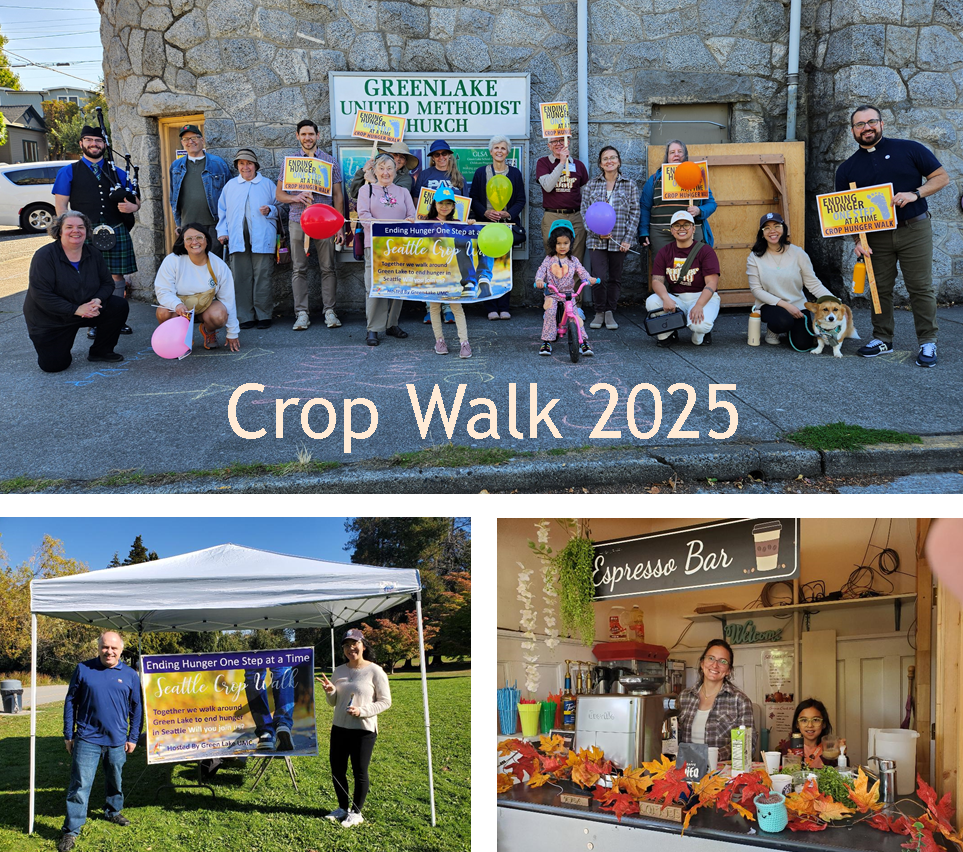
As a church, we have many upcoming opportunities to practice being who we say we are. We have hired two new Christian education staff, Thuy-Linh Bui and Robin Jones, to help teach our children what it means to follow Jesus. We are transforming our community through intentionally welcoming the stranger on Sunday mornings. We are coordinating the North Seattle CROP Walk, raising money with other area churches for hungry people around the world.

There is a quote on my office door from the Jesuit priest Teilhard de Chardin. It reads, “Above all, trust in the slow work of God. . . . Only God could say what this new spirit gradually forming within you will be. Give our Lord the benefit of believing that his hand is leading you, and accept the anxiety of feeling yourself in suspense and incomplete.”

We are all of us incomplete, always able to be changed by the slow work of God in our hearts. To transform the world, we must first let God transform our hearts.

What is God doing in your heart? Where do you hear a call to deepen your Christian discipleship? How will you transform the world?
I can’t wait to find out.

May the peace of Christ be with you always,

Pastor Meredith

Moving Into The Neighborhood

“The Word became flesh and blood, and moved into the neighborhood.”

(John 1:14, The Message)

Next week, my family and I will move into the parsonage. Moving makes me

nervous, but it also makes me excited.  Living closer to the people of this

congregation, I will be able to visit folks more easily, shop where they shop,

participate in the same community events. I am hopeful that living in Green Lake will help me connect with neighbors outside our congregation, those who walk past our building but may not know our people.  My first job as pastor is to love people as God loves them, and being near people makes love easier to express.

Moving has risks. Will I like my new place? Will I be welcomed as a new neighbor? What if I don’t fit in? What if people just want to avoid me?

Loving has risks. I love how The Message translates this verse from the gospel of John; when God becomes flesh to dwell among us, he “moves into the neighborhood.” Jesus was not always welcomed as a neighbor, but he was always welcoming, turning none away. He moved into the neighborhood of our world, a neighborhood in which he was sometimes rejected, but he continued to love people, no matter what.

As Christians, we are called to love our neighbors as ourselves. As the people of Green Lake United Methodist Church, we are called to love whoever shows up on our doorstep, extending to them the same hospitality we show to those we have loved for many years.

The neighborhood of our congregation is changing, and not only because I am moving into the parsonage. Last Sunday alone, we had seven new visitors at worship.  And, just as my new neighbors did not choose my family, we do not get to choose who comes into our community.  The changing neighborhood of our congregation may include families with children, single people, people living with mental illness, college students, older adults, people without homes, gay and lesbian people. Sometimes God sends us the people we have been praying for; sometimes God sends us the people we need to meet.

When Jesus was asked the question, “Who is my neighbor?” he responded by telling the story of the good Samaritan, the one who stops to help a robbery victim instead of walking right on past. Jesus concludes this story with the following words:

“What do you think? Which of the three became a neighbor to the man attacked by robbers?’

‘The one who treated him kindly,’ the religion scholar responded.

Jesus said, ‘Go and do the same.’” (Luke 10:37, The Message)

May we remember to treat each other kindly. May we be good neighbors.

May the peace of Christ be with you always,

Pastor Meredith